Service FileDossier de Service
- Reg. #Matricule o165
- RankGrade Sub/Constable
- NameNom John T. Cherry
- BornNé Kingston, OntarioKingston, Ontario
- EnlistedEnrôlé March 28, 1874 — Kingston, ON28 mars 1874 — Kingston, ON
- DivisionDivision ‘F’ Division — last Troop in the March West columnDivision ‘F’ — dernière troupe dans la colonne de la Marche vers l’Ouest
- March WestMarche vers l’Ouest Fort Dufferin, Manitoba to present-day Alberta — over 900 milesFort Dufferin, Manitoba jusqu’en Alberta actuelle — plus de 1 400 km
- DischargeLibération May 11, 1877 — Fort Macleod — ‘time expired’11 mai 1877 — Fort Macleod — ‘temps expiré’
- Age at dischargeÂge à la libération 22 years — 5′7″, grey eyes, brown hair, fresh complexion22 ans — 5′7″, yeux gris, cheveux bruns, teint frais
- Post-serviceAprès le service Sailor and Captain on the Great LakesMarin et capitaine sur les Grands Lacs
- DiedDécédé 19201920
- BuriedInhumé St. Mary’s Catholic Cemetery, Kingston, OntarioCimetière catholique St. Mary, Kingston, Ontario
- LegacyHéritage Paternal grandfather of Don Cherry, CBC Coach’s CornerGrand-père paternel de Don Cherry, CBC Coach’s Corner
The March West — 135th Anniversary
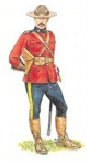
To commemorate the 135th anniversary of the RCMP on May 23rd, 2008, we take time to remember a man who was among the first to join the North West Mounted Police (NWMP) in 1874 and who rode in the March West. With so many others, he faced the unknown challenges of the Canadian west and did his duty as a Mounted Policeman. He’s our first Vet of the Month.
Our Vet was born and raised in Kingston, Ontario. At 19 years of age, he successfully joined the NWMP. One can speculate about his desire to join the NWMP; he may have been seeking work or perhaps he wanted to travel or perhaps he heard about the opening of the Canadian west and was looking for adventure.
He enlisted in the NWMP at Kingston on March 28th, 1874 as Regimental #o165. Soon after in Toronto, it is known that Commissioner French warned the early recruits of the dangers that lay ahead. He said: “…I plainly told them that they would have, and must expect, plenty of hardship; they might be wet day after day, and have to lie in wet clothes; that they might be a day or two without food, and that I feared they would often be without water, and I called on any present who were not prepared to take their chances of these privations to fall out…there were plenty of good men to take their places”. (Cruise & Griffiths, p.176–177).
Our young and gritty recruit did not quit. Within three months, he was squaded into ‘F’ Division — the last Troop in the column of men which formed the March West. He rode a bay steed and he resolutely completed the journey from Fort Dufferin, Manitoba to present day Alberta, a distance of over 900 miles.
Our Vet’s Police Service Record is sparse, however, we are still able to gain a glimpse into his career and garner a sense of his personality from the details that are available. Also, we can place him in context as much is known about the difficulties faced by both the early pioneers and the police patrols who sought to tame the West.
Accounts tell of the exhaustion of the NWMP men as they plodded westward. They worked without proper food, equipment or rest. Uniforms were ill-fitted and of poor quality offering little protection from the unpredictable weather. Whenever they could sleep it was on ant infested ground.
In addition to foul weather, bugs and flies tormented both horse and rider. Stories are told whereby horses had to be destroyed by their police owners because of the unendurable torture suffered due to clouds of flies which got into the animals’ nostrils and eyes. Indeed men suffered as well, and neither doctors nor dentists were available to ease pain and cure illness. Such were the conditions faced by our recruit.
Strict military discipline was not a strong attribute of most of the early NWMP recruits. Our Vet certainly fell into that category and very likely he found the adjustment into police ranks very difficult and testy. Early in his career, he had several charges brought against him by Senior Officers.
In July, 1874 he was charged with: ‘Not complying with an order’ and fined $3.00. In August, 1874 he faced three more disciplinary charges, including: ‘Insolence’, ($2.00 fine), ‘Disobedience of an order by riding in a wagon’ ($2.00 fine) and ‘Neglect of duty in allowing a horse to get away’ (fine $10.00).
In September, 1874, he was again cited for another ‘Disobedience of an order’ and fined $15.00. Given that he was making .75 a day, one can see that he had trouble saving any of his earnings. As the fines increased, it also seems that our constable changed his ways as there were no more disciplinary matters noted in his record.
He served in the NWMP for 3 years and 44 days before taking his discharge, at Fort Macleod as ‘time expired’ on May 11th, 1877. In the NWMP, at that time, all members served for a specific period of time and if they were not interested in further service, then their ‘time expired’ and they were discharged accordingly.
Upon his discharge at age 22, he appeared slight of build and stood at 5′7″ tall. His eyes were grey, his hair was brown and his complexion was described as ‘fresh’. One can get a fairly good visual image of our Vet from this description.
He returned to Kingston where he became a sailor and Captain on the Great Lakes. He died in 1920 and he is buried in St. Mary’s Catholic Cemetery in Kingston, Ontario. His occupation is listed as ‘Captain’ in the Cemetery Registry.
Cherry is a surname familiar to Canadians and our Vet of the Month is Sub/Constable John T. Cherry. Our brave and gritty figure is the paternal grandfather of Canada’s famous Coach’s Corner CBC hockey commentator, Mr. Don Cherry.
We tip our Stetson to John T. Cherry of the North West Mounted Police (NWMP).
La Marche vers l’Ouest — 135e anniversaire
Pour commémorer le 135e anniversaire de la GRC le 23 mai 2008, nous prenons le temps de nous souvenir d’un homme qui fut parmi les premiers à rejoindre la Police à cheval du Nord-Ouest (PCNO) en 1874 et qui participa à la Marche vers l’Ouest. Avec tant d’autres, il fit face aux défis inconnus de l’Ouest canadien et accomplit son devoir en tant que policier à cheval. Il est notre premier Vétéran du Mois.
Notre vétéran est né et a grandi à Kingston, en Ontario. À 19 ans, il réussit à rejoindre la PCNO. On peut spéculer sur son désir de rejoindre la PCNO ; il cherchait peut-être du travail, ou voulait peut-être voyager, ou avait peut-être entendu parler de l’ouverture de l’Ouest canadien et était en quête d’aventure.
Il s’enrôla dans la PCNO à Kingston le 28 mars 1874 sous le matricule #o165. Peu après, à Toronto, le commissaire French avertit les premières recrues des dangers qui les attendaient. Il dit : «…Je leur ai clairement dit qu’ils auraient, et devaient s’attendre à, beaucoup d’épreuves ; qu’ils pourraient être mouillés jour après jour et devoir dormir dans des vêtements mouillés ; qu’ils pourraient être un jour ou deux sans nourriture, et que je craignais qu’ils manquent souvent d’eau, et j’ai demandé à tous ceux qui n’étaient pas prêts à affronter ces privations de se retirer…il y avait beaucoup de bons hommes pour prendre leur place». (Cruise & Griffiths, p.176–177).
Notre jeune recrue tenace ne capitula pas. En moins de trois mois, il fut intégré à la Division ‘F’ — la dernière troupe dans la colonne d’hommes qui forma la Marche vers l’Ouest. Il chevauchait un destrier bai et compléta résolument le voyage de Fort Dufferin, au Manitoba, jusqu’à l’actuelle Alberta, une distance de plus de 1 400 kilomètres.
Le dossier de service policier de notre vétéran est fragmentaire, cependant nous pouvons encore entrevoir sa carrière et saisir sa personnalité à partir des détails disponibles. De plus, nous pouvons le situer dans son contexte, car on sait beaucoup sur les difficultés auxquelles faisaient face les premiers pionniers et les patrouilles de police qui cherchaient à dompter l’Ouest.
Les récits témoignent de l’épuisement des hommes de la PCNO qui progressaient laborieusement vers l’ouest. Ils travaillaient sans nourriture adéquate, sans équipement ni repos. Les uniformes étaient mal ajustés et de mauvaise qualité, offrant peu de protection contre les caprices du temps. Quand ils pouvaient dormir, c’était sur un sol infesté de fourmis.
Outre le mauvais temps, les insectes et les mouches tourmentaient cavaliers et chevaux. On raconte que des chevaux durent être abattus par leurs propriétaires policiers en raison des souffrances insupportables causées par des nuages de mouches qui pénétraient dans les naseaux et les yeux des animaux. Les hommes souffraient également, et ni médecins ni dentistes n’étaient disponibles pour soulager la douleur et guérir les maladies. Telles étaient les conditions auxquelles notre recrue était confrontée.
La stricte discipline militaire n’était pas une qualité marquante de la plupart des premières recrues de la PCNO. Notre vétéran appartenait certainement à cette catégorie et il est très probable qu’il trouva l’adaptation aux rangs policiers très difficile et irritante. Tôt dans sa carrière, plusieurs accusations furent portées contre lui par des officiers supérieurs.
En juillet 1874, il fut accusé de ‘ne pas avoir obéi à un ordre’ et condamné à une amende de 3,00 $. En août 1874, il fit face à trois autres accusations disciplinaires, notamment : ‘Insolence’ (amende de 2,00 $), ‘Désobéissance à un ordre en montant dans un chariot’ (amende de 2,00 $) et ‘Négligence de devoir en laissant un cheval s’échapper’ (amende de 10,00 $).
En septembre 1874, il fut de nouveau cité pour une autre ‘Désobéissance à un ordre’ et condamné à une amende de 15,00 $. Étant donné qu’il gagnait 0,75 $ par jour, on comprend qu’il avait du mal à épargner. À mesure que les amendes augmentaient, il semble également que notre gendarme ait changé de comportement, car aucune autre infraction disciplinaire ne fut notée dans son dossier.
Il servit dans la PCNO pendant 3 ans et 44 jours avant d’obtenir sa libération à Fort Macleod, son ‘temps ayant expiré’, le 11 mai 1877. Dans la PCNO, à cette époque, tous les membres servaient pour une période déterminée et s’ils ne souhaitaient pas prolonger leur service, leur ‘temps expirait’ et ils étaient libérés en conséquence.
À sa libération à 22 ans, il paraissait de constitution légère et mesurait 5′7″. Ses yeux étaient gris, ses cheveux bruns et son teint était décrit comme ‘frais’. On peut se faire une assez bonne image visuelle de notre vétéran à partir de cette description.
Il retourna à Kingston où il devint marin et capitaine sur les Grands Lacs. Il mourut en 1920 et est inhumé au cimetière catholique St. Mary à Kingston, en Ontario. Son occupation est inscrite comme ‘Capitaine’ dans le registre du cimetière.
Cherry est un nom de famille familier aux Canadiens et notre Vétéran du Mois est le sous-gendarme John T. Cherry. Notre personnage courageux et tenace est le grand-père paternel du célèbre commentateur de hockey de CBC Coach’s Corner, M. Don Cherry.
Nous soulevons notre Stetson à John T. Cherry de la Police à cheval du Nord-Ouest (PCNO).
Source
Cruise, D., & Griffiths, A. (1996). The Great Adventure: How The Mounties Conquered The West. Toronto: Penguin Books Canada.
I would also like to acknowledge the help with research provided by my friend Glenn Wright, RCMP Historian. Glenn provided details of John T. Cherry’s life which made this story more authentic.
Source
Cruise, D., & Griffiths, A. (1996). The Great Adventure: How The Mounties Conquered The West. Toronto : Penguin Books Canada.
Je tiens également à remercier mon ami Glenn Wright, historien de la GRC, pour son aide à la recherche. Glenn a fourni des détails sur la vie de John T. Cherry qui ont rendu cette histoire plus authentique.
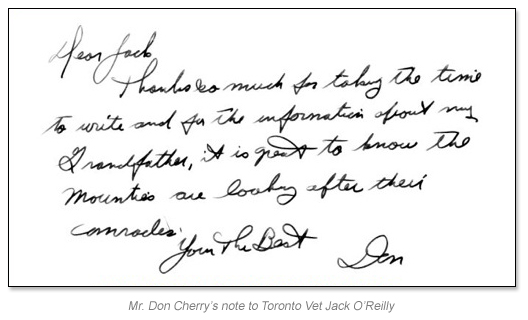
Mr. Don Cherry’s note to Toronto Vet Jack O’Reilly Note de M. Don Cherry au vétéran torontois Jack O’Reilly
From Don CherryDe Don Cherry
‘Dear Jack,
Thanks so much for taking the time to write and for the information about my Grandfather. It is great to know the Mounties are looking after their comrades.
You’re the best, Don.’
‘Cher Jack,
Merci beaucoup d’avoir pris le temps d’écrire et pour les informations sur mon grand-père. C’est formidable de savoir que les Gendarmes prennent soin de leurs camarades.
Tu es le meilleur, Don.’
Mr. Don Cherry’s photo & note to Ottawa Vet Buffalo Joe Healy Photo et note de M. Don Cherry au vétéran d’Ottawa, Buffalo Joe Healy
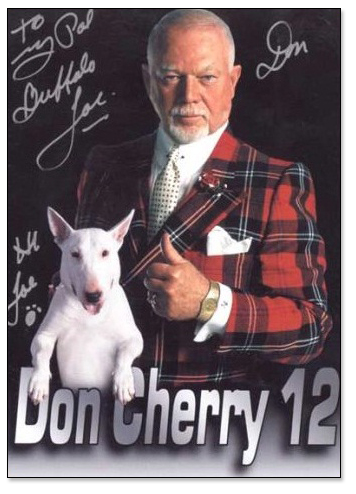
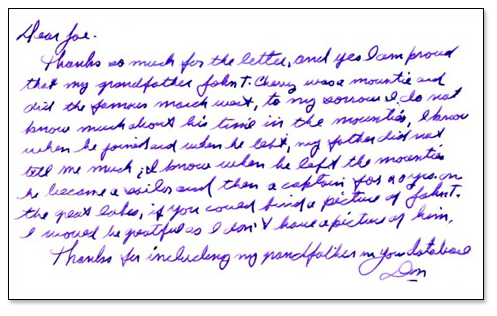

From Don CherryDe Don Cherry
‘Dear Joe,
Thanks so much for the letter, and yes I am proud that my grandfather John T. Cherry was a mountie and did the famous March West. To my sorrow, I do not know much about his time in the mounties.
I know when he joined and when he left, my father did not tell me much. I know when he left the mounties, he became a sailor and then a captain for 40 years on the Great Lakes. If you could find a picture of John T. I would be grateful as I don’t have a picture of him.
Thanks for including my grandfather in your database, Don.’
‘Cher Joe,
Merci beaucoup pour la lettre, et oui je suis fier que mon grand-père John T. Cherry ait été gendarme à cheval et ait participé à la fameuse Marche vers l’Ouest. À mon grand regret, je ne sais pas grand-chose de son temps chez les gendarmes.
Je sais quand il a rejoint et quand il est parti, mon père ne m’en a pas dit grand-chose. Je sais que quand il a quitté les gendarmes, il est devenu marin puis capitaine pendant 40 ans sur les Grands Lacs. Si vous pouviez trouver une photo de John T., je vous en serais reconnaissant car je n’en possède pas.
Merci d’avoir inclus mon grand-père dans votre base de données, Don.’
Grave Markers (2008) of Reg.#o165 Sub/Constable John T. Cherry Pierres tombales (2008) du Reg.#o165 Sous-gendarme John T. Cherry
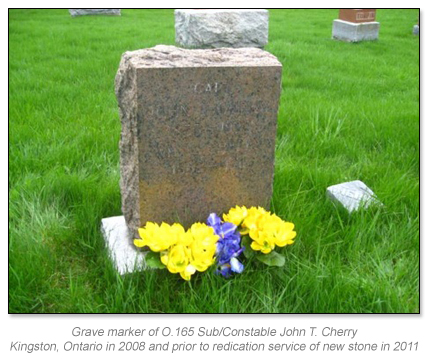
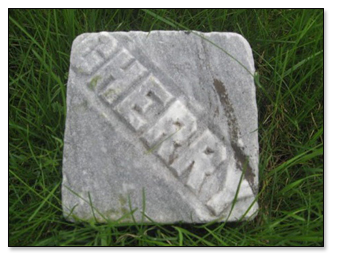
Memorial Service — November 16, 2011 — Kingston, ON Service commémoratif — 16 novembre 2011 — Kingston, ON
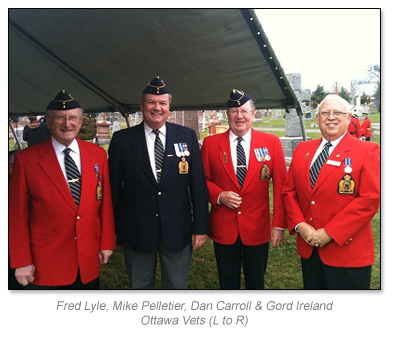
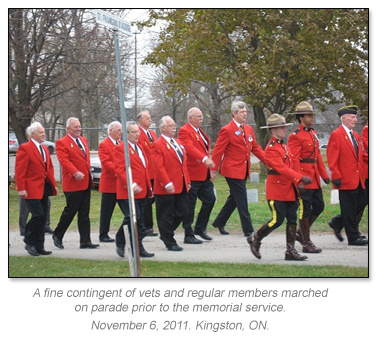
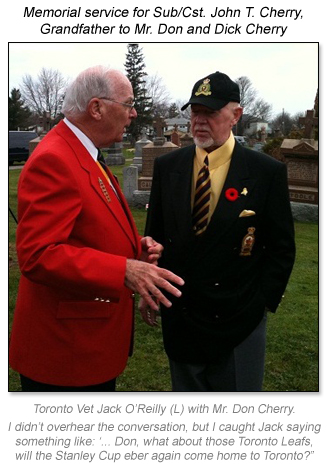
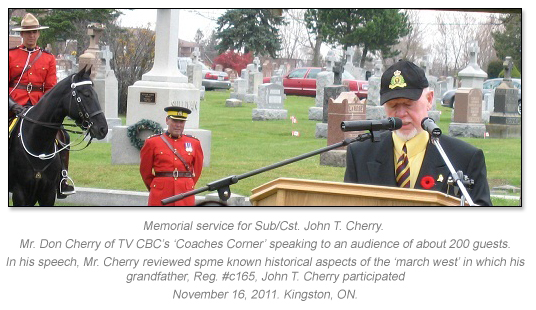
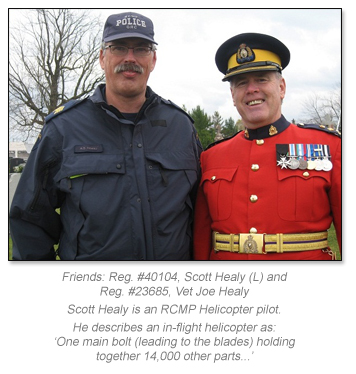
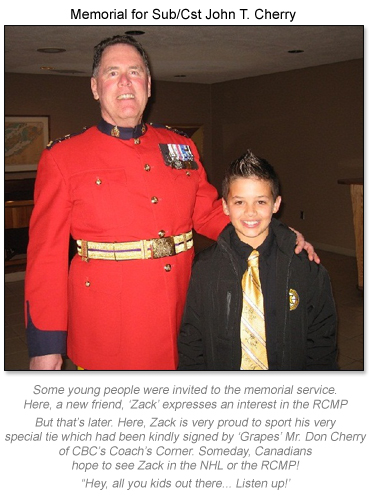
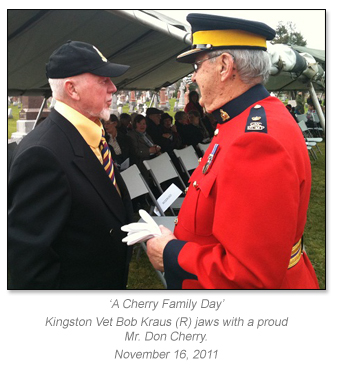
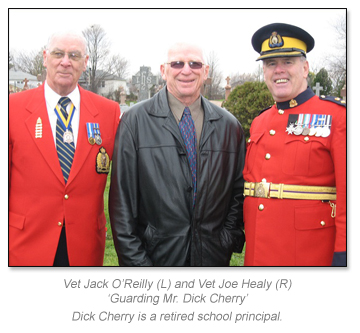
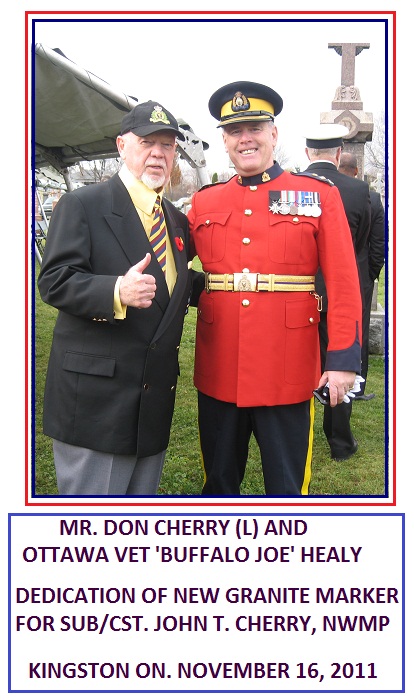
The photos which follow were taken on November 16, 2011 in Kingston, ON at the Memorial Service held in honour of Reg.#o165 Sub Constable John T. Cherry, paternal grandfather to Mr Don Cherry and Mr Dick Cherry. Les photos qui suivent ont été prises le 16 novembre 2011 à Kingston, en Ontario, lors du service commémoratif tenu en l’honneur du Reg.#o165 Sous-gendarme John T. Cherry, grand-père paternel de M. Don Cherry et de M. Dick Cherry.
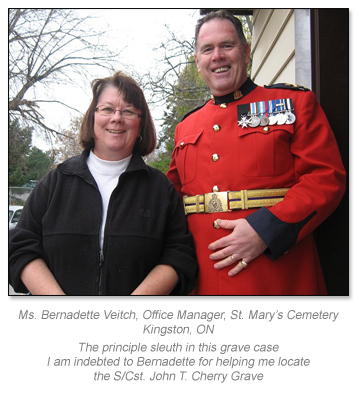
(Below) I am also very, very grateful to Ms Bernadette Freeburn, Administrator of St. Mary’s Catholic Cemetery for helping me to locate Sub Constable John Cherry’s grave site in Kingston, ON. (Ci-dessous) Je suis également très, très reconnaissant envers Mme Bernadette Freeburn, administratrice du cimetière catholique St. Mary, qui m’a aidé à localiser la sépulture du sous-gendarme John Cherry à Kingston, en Ontario.
Reporting from Fort Healy · J. J. Healy · May 23, 2008 Reportage depuis Fort Healy · J. J. Healy · 23 mai 2008
↑ Back to TopRetour en haut ← Back to Vet of the MonthRetour au Vétéran du Mois